


Teeth cleaning

Brush your teeth at least twice a day with a fluoride toothpaste.
It is very important to always brush the teeth before going to bed. Brushing should last for about 2 minutes.
It is very important to always brush the teeth before going to bed. Brushing should last for about 2 minutes.

Use a toothbrush with small head, straight nylon bristles and moderate hardness.
Your dentist will recommend a soft toothbrush if appropriate for you.
Your dentist will recommend a soft toothbrush if appropriate for you.
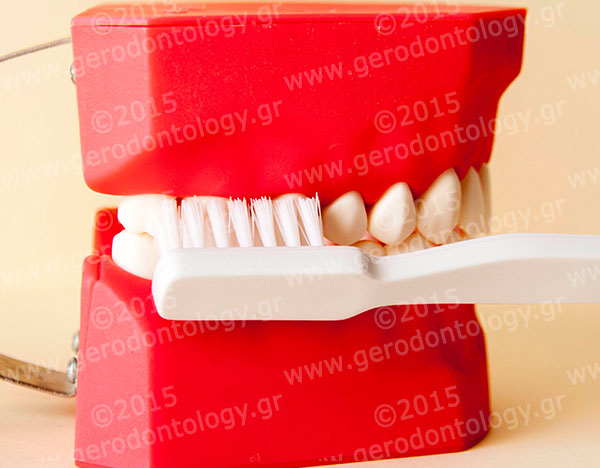
Place the brush at an angle of 45 degrees to the teeth, so that the bristles are gently placed in the gingival sulcus (the area between teeth and gums).
Brush two or three teeth at a time using a short back and forth motion (10 times).
Finally, drag the brush towards the occlusal surface of the teeth (2-3 movements) to remove dental plaque
Brush two or three teeth at a time using a short back and forth motion (10 times).
Finally, drag the brush towards the occlusal surface of the teeth (2-3 movements) to remove dental plaque

The occlusal surfaces are brushed back and forth and inside-out.

To brush the lingual part of the front teeth (incisors) place the toothbrush upright and make small circular movements on each tooth.

Brush the back surface of the last tooth.
Sometimes it helps to brush the teeth in front of a mirror to make sure it is performed correctly.
Clean all three surfaces of the teeth, the occlusal, the buccal (external) and the lingual (internal).

Click on image to enlarge
Click on image to enlarge

Click on image to enlarge
First clean the outer surfaces, from left to right (figures 1-8).

Then, clean the occlusal surfaces (figures 1-3).

And finally clean the lingual surfaces (figures 1-4).

Brush the tongue to remove bacteria causing bad breath or infections in the mouth and dentures.

After brushing the teeth, rinse the toothbrush thoroughly under tap water to remove the toothpaste and the food remnants and let it air dry.
Do not use a toothbrush cover.
Do not use a toothbrush cover.

- If you have trouble holding the toothbrush with your hands (for example if you suffer from arthritis) you can thicken the handle by various means (rubber, cloth) or bend it in hot water. Alternatively you can use electric toothbrush.
- If you cannot brush your teeth, seek the help of another person if available.
Cleaning the interdental spaces at least once a day, preferably before bed, is as important as brushing the teeth.
You can use dental floss, a floss holder or interdental brushes.
Sometimes when you first start cleaning the interdental spaces your gums hurt or bleed. Don’t stop flossing. If you insist, the bleeding and the symptoms will subside after a few days. If the pain persists visit your dentist.
You can use dental floss, a floss holder or interdental brushes.
Sometimes when you first start cleaning the interdental spaces your gums hurt or bleed. Don’t stop flossing. If you insist, the bleeding and the symptoms will subside after a few days. If the pain persists visit your dentist.
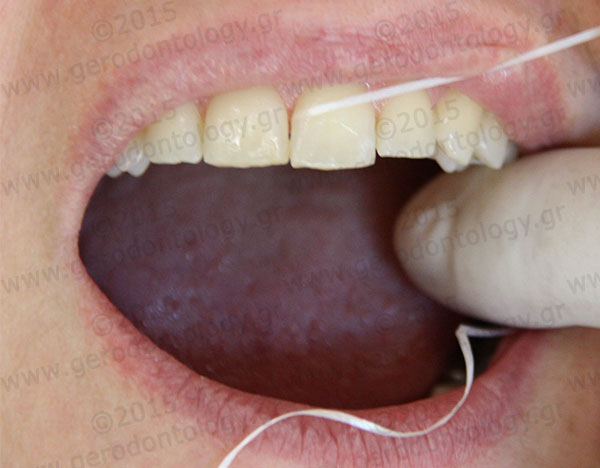
To use the dental floss cut a piece of 20-25 cm long and make a loop on the side surface of the tooth making up and down motion.
Pull the floss down to the gingival sulcus. Then embrace the side surface of the adjacent tooth and continue with the same movement.
There are several types of dental floss (i.e. waxed, unwaxed). Ask your dentist which is the most appropriate type for you.
Pull the floss down to the gingival sulcus. Then embrace the side surface of the adjacent tooth and continue with the same movement.
There are several types of dental floss (i.e. waxed, unwaxed). Ask your dentist which is the most appropriate type for you.

If you find difficult to use the dental floss use a floss holder.
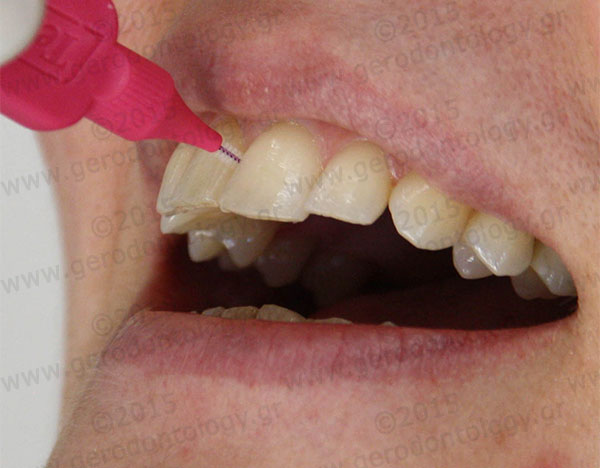
You may also use interdental brushes.
The buccal and the lingual areas of crowns and bridges are brushed in the same way as natural teeth.
To clear the spaces under the bridges use super floss and / or interdental brushes.
Super floss

Interdental brushes.

It is not advisable to use a mouthwash without prior dental consultation.
The use of a mouthwash alone does not effectively clean the teeth.
The use of a mouthwash alone does not effectively clean the teeth.